

Pre-sales customer service WeChat


What is the composition and identification working principle of the barcode scanning gun?
Release Time:2020-07-21
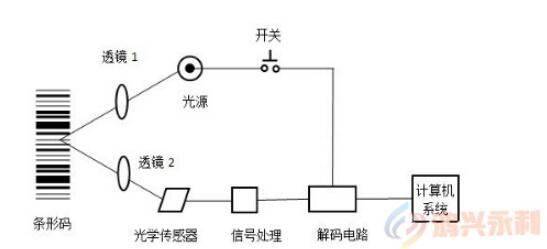
What is the working principle of the barcode scanning gun/scanner, and how is its identification data transmitted to the computer? The barcode scanner is generally composed of a light source, an optical lens, a scanning module, an analog-to-digital conversion circuit and a plastic shell.
Barcode Overview-Barcode Identification Principle (Barcode Identification Principle) Barcode was first proposed by N.T. Woodland of the United States in 1949. With the increasing popularity of computer applications, the application of bar codes has been greatly developed. Barcode can mark the country of production, manufacturer, commodity name, production date, book classification number, mail start and end location, category, date and other information, so it has been widely used in many fields such as commodity circulation, book management, post and telecommunications management, banking system and so on.
Bar code is by far one of the most economical and practical automatic identification technology, not only the input speed is fast, but also the reliability is high, and the error rate is less than one in a million. In addition, its production is also very simple, there are no special requirements for equipment and materials, and the equipment and production costs are low.
The working principle of laser gun
Laser scanners are relatively expensive among various scanners, but they provide the highest functional indicators, so they are widely used in various industries.
The basic working principle of the laser scanner is: the handheld laser scanner emits a beam of light through a laser diode, which is irradiated on a rotating prism or a mirror that swings back and forth. The reflected light passes through the reading window and is irradiated on the bar code surface. The light returns to the reader after being reflected by the bar or empty, and is collected and focused by a mirror, and converted into an electrical signal through a photoelectric converter, the signal will be decoded by the decoding software on the scan session or terminal.
The laser scanner is divided into two forms: handheld and fixed: handheld laser gun connection is convenient and simple, flexible to use, fixed laser scanner is suitable for reading the largest, bar code smaller occasions, effectively free hands to work.
Advantages: Laser scanner can be used for non-contact scanning. Under normal circumstances, laser reader is the only choice when the reading distance exceeds 30cm. Laser reading bar code has a wide range of density and can read irregular bar code surfaces or through glass or transparent adhesive paper, because it is non-contact reading, so bar code labels will not be damaged. Because of the advanced reading and decoding system, the first reading recognition success rate is high, the recognition speed is faster than the light pen and CCD, and the bar code recognition effect is good for poor printing quality or fuzzy; the error rate is extremely low (only about one in three million).
Focus on us
Official Account
Pre Sales
After Sales
National Service Hotline
Complaint suggestion:+86 13530144755
Enterprise E-mail:wanglili@xingyongli.com
Links:Shenzhen Hongxing Yongli Electronic Technology Co., Ltd.(Apply for friend chain plus QQ:2355671558)
©2024 Shenzhen Hongxing Yongli Electronic Technology Co., Ltd Powered by www.300.cn