

Pre-sales customer service WeChat


Do you know how the bar code was invented?
Release Time:2020-07-21
Do you know how bar codes were invented? Bar codes have already penetrated into every link of the production supply chain, from production to transportation and tracking to distribution, and every link has become easier and faster because of the existence of bar codes. In 2013, according to GS1 (the organization that manages and distributes barcodes), the average number of barcode scans per day worldwide exceeded 0.5 billion.
The past history of bar code development
Imagine a department store without a bar code: supermarket operators need to spend a lot of money to record the name and price of each item, supermarkets need to regularly count and record the quantity of goods stored, and salespeople need to record the goods sold one by one. As early as the beginning of the 19th century to the end of the 20th century, businessmen engaged in the production and supply of products, especially large supermarkets, realized this: with the improvement of people's consumption level, the demand for products and the gradual increase of product types, they need a more efficient and faster production and supply system. In 1932, a Harvard Business School student named Wallace Flint proposed in his master's thesis that punch cards (punchcard) could be used in large supermarkets.
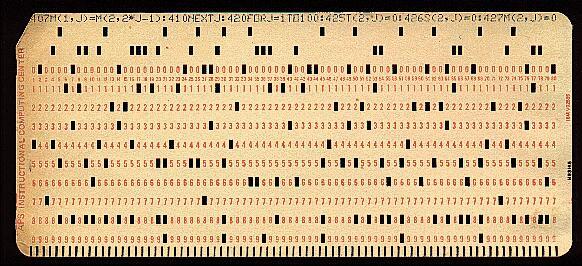
in the checkout system. This system works like this: when customers enter the supermarket, they will get such a punch card, which is actually equivalent to a menu. Customers select the things they want to buy, then punch holes corresponding to the goods on the punch card, give the card to the salesperson when checking out, and the salesperson will insert it into a machine that can read the punch card, then the corresponding products will be shipped out of the warehouse. The idea was very good, but the machines that could read punch cards were very expensive and very large and clumsy, a method that was not taken at the time.
Then came the origins of the modern bar code. Bernard Silver, a graduate of Philadelphia's Drexel Institute of Technology in 1949, overheard a conversation between the owner of a restaurant chain and their dean: he hoped that the dean could help him research and develop a system that could automatically record commodity information at checkout, and was brutally rejected by the dean. Silver later mentioned the matter with his friend Norman Joseph Woodland. The two of them thought it could be done, so they began to study it. Inspired by Morse code, the two developed and patented a bullseye codebullseye code that could be scanned from any direction.
However the problem is that the code is there, but they don't really have a machine that can scan and record the information in it.
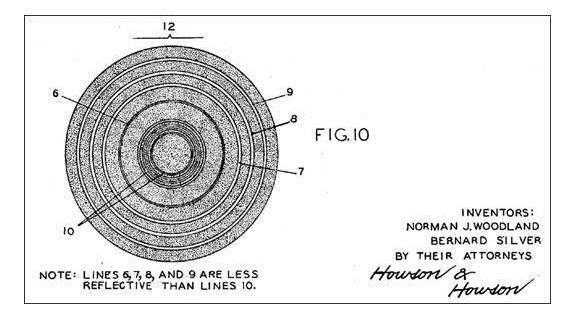
Woodland joined IBM in 1951. Since then, he and Silver have been studying machines that can scan codes. However, the same problem has always existed as before: the machines are too heavy and expensive, which leads to their research has not been put into practical application. (This technology was not applied until Silver died)
It wasn't until a decade or two later that another technology made scanning possible: lasers. The scanner was finally invented and put into use. In 1971, in order to unify the code scanning world (during which many codes were invented and applied in different places),IBM released the commodity unified code UPC(Universal Product Code), which has been used until now, and made great efforts to promote it to be widely used.
June 26, 1974 was a historic day in the world of yards sweeping.
At 8: 01 this morning, Marsh Supermarket in Troy,Ohio (Troy,Ohio) sold the first product with UPC in history-Wrigley gum in ten packages. Silver,Woodland and countless others have worked hard for nearly half a century to finally become a reality at this moment. However, at that time, many people still expressed doubts about this: some people thought it could be used to monitor consumers, and some TV stations even reported that this was a company-to-consumer conspiracy. Due to people's lack of understanding and suspicion of bar codes, the initial expansion of bar codes was very slow. Even two years later, in 1976, BusinessWeek wrote a report with the title "The Supermarket Scanner that Failed.
Despite this, the reduction in manpower that bar codes can bring, the great convenience of procedures and the reduction in costs have led more and more large supermarket chains to adopt this technology.
By 1980, 8000 stores a year were putting barcodes into use.
In 1991, almost all items in all stores were marked with bar codes.
In 1992, Woodland and Bill Gates were honored by President Bush at the White House for their contributions to science and technology (Woodland contributions to science and technology are not just bar codes).
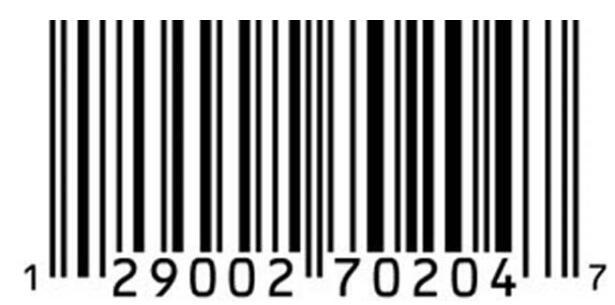
The above picture is the standard UPC12 bar code. Take this bar code as an example, the first six 129002 are the number of the production company (Manufacturer Identification Number), the last five are the number of the company's product (Item Numerbr), and the last digit is the verification number (Check Number). The first six company numbers are distributed to the production companies through the Uniform Coding Committee (Uniform Code Council), and their products are numbered and attached internally, with each product corresponding to a number. The existence of the verification number ensures that the product will not go wrong at the checkout, and it works like this:
Add up the numbers of odd digits. In the above figure, 1 9 0 7 2 4=23 multiply this number by 3, 23*3=69 add up the even digits. In the above figure, 2 0 2 0 0=4 add up this number with the number obtained in the second step. 4 69=73 find the number that can make this number (73) a multiple of 10, this is 7(73 7=80), which is the verification number of this bar code.
During the checkout process, the scanner will calculate the scanned barcode to obtain a number. If it is different from the verification number, the salesperson will usually re-scan or manually enter the number under the barcode. The information and pricing of all products are stored in the central computer of the supermarket. When the scanner scans a correct bar code, the code will be sent to the central computer, and then the central computer will send the pricing of the products back to the checkout. The whole process only requires the salesperson to scan the products. But at the same time, it also means that supermarkets can arbitrarily modify product pricing, thereby deceiving consumers to obtain higher profits.
It is also mentioned above that the salesperson can manually enter 12 digits to check out, that is to say, the 12 digits in the above figure are encoded into those bar codes: the thick and thin vertical lines in the above figure actually correspond to one number after another. Observe the thinnest black vertical line in the above figure. This is a unit width (one unit wide). Vertical lines of different widths are a combination of several unit widths. Combined with blank vertical lines (the same principle as black vertical lines), these numbers 0-9 can be encoded:
0:3-2-1-1 (white line-black line-white line-black line)
1:2-2-2-1
2:2-1-2-2
3:1-4-1-1
4:1-1-3-2
5:1-2-3-1
6:1-1-1-4
7:1-3-1-2
8:1-2-1-3
9:3-1-1-2
Observe that the above figure starts from the place where the bar code is embedded upward, 2 is 2-1-2-2, the white line of two units, the black line of one unit, the white line of two units, and the black line of two units. 9 is 3-1-1-2, three units of white line, one unit of black line, one unit of white line, two units of black line, and so on to the penultimate position 4,1-1-1-1-3-2. The numbers at the beginning and end (1 and 7) have special codes.
The history of the invention and application of bar code technology also reveals the essence of scientific progress, that is, the combination and re-creation of existing technologies. Many inventions can only be realized on a more mature basis in many fields. For example, bar code technology received a patent for bullseye code in Woodland1951 years. However, it was not until 10 or 20 years later that the code scanning technology was realized with the advent of laser technology. Similarly, Woodland inventions can only be developed on the basis of understanding Morse code. Such examples are numerous in the history of scientific development.
Dear customer, thank you for visiting our website. I am very happy to serve you!
Shenzhen Hongxing Yongli Company upholds the determination to carry out the bar code to the end! One-stop supply of major brands of barcode scanners, barcode printers, data collectors and other barcode hardware and software equipment. provide scanning gun setup questions answered free of charge, barcode printer driver software download, barcode management system applications in different industries. National unified service consultation: 4008-330-370
Focus on us
Official Account
Pre Sales
After Sales
National Service Hotline
Complaint suggestion:+86 13530144755
Enterprise E-mail:wanglili@xingyongli.com
Links:Shenzhen Hongxing Yongli Electronic Technology Co., Ltd.(Apply for friend chain plus QQ:2355671558)
©2024 Shenzhen Hongxing Yongli Electronic Technology Co., Ltd Powered by www.300.cn