

Pre-sales customer service WeChat


Bus QR code payment POS starts trial operation
Release Time:2015-06-18
The public transportation two-dimensional code payment POS has begun to be put into trial operation. The opportunities and challenges it faces are not only the application of two-dimensional codes in open-loop payment, but also the appearance of two-dimensional codes in various original closed-loop card application scenarios. Among them, public transportation payment has attracted much attention and is also controversial, which is considered to be the most advantageous field for NFC application.
Two-dimensional code traffic payment pilot continues
At the beginning of 2016, Guangzhou Metro APM line launched two-dimensional code payment, which caused a heated discussion in the industry. Transportation payment is not only NFC, but also two-dimensional code is also being tried. However, APM traffic is less, and the gate is not all support two-dimensional code, and then the industry.
But a wave of just flat wave after wave, August 11, Alipay in Hangzhou took the lead in the pilot sweep code bus. The unique "bus code" is used, which is different from the Alipay payment code used in convenience stores, restaurants and other scenes, and a special security encryption algorithm is used to carry out secure offline verification only for the special code scanner on the bus. In this way, it is possible to realize the bus payment of two-dimensional code. If the pilot is successful, it will be extended to the national bus.
Soon after, Jinan also launched Alipay two-dimensional code bus payment. Jinan bus cooperated with Alipay to run Alipay "bus payment" two-dimensional code swipe card on K52 road from September 22 to December 31. To use Alipay's "bus payment" function, you need to update the Alipay client to the latest version and open the "Hua Bai" function. Open Alipay APP, click "all" on the front page, then enter "city service" and click "bus payment" to generate a two-dimensional code. When this two-dimensional code is close to the code scanner under the bus card reader, a "ding" sound is issued and the payment is successful. The scan code time is basically the same as the swipe time of the bus card. Up to now, an average of 113 people use QR codes for bus payment every week, which is already considerable for a bus line, and the average daily usage is relatively stable and growing steadily, which shows that passengers are used to using QR codes for bus payment.
Not only the two-dimensional code payment under the Internet giant, but also the bus company also realizes the two-dimensional code payment through the release of APP. In August this year, Zhejiang Jinhua Public Transport Group launched Jinhua Bank APP, which generates two-dimensional code electronic tickets to complete public transport payment.
The activity of open-loop two-dimensional code payment has given birth to the application of closed-loop payment scenarios. Judging from the current market situation, both Internet giants and bus companies will have more and more regional pilot and even online two-dimensional code traffic payment.
What opportunities does the QR code bus payment bring
Emerging market applications will inevitably lead to the development of related enterprises. First of all, the good thing is that the manufacturers of bus POS will have more comprehensive thinking on the payment experience due to their understanding of the application environment of bus POS and the addition of two-dimensional codes. Bus POS/IC card integrated charging terminal with two-dimensional code on board. It is particularly worth mentioning that the scanning area of the POS is located at the lower end of the fuselage, which makes the posture of passengers more natural when making bus payment. As a relatively crowded environment, the bus requires higher convenience. At the same time, this POS also supports ordinary bus card payment, which is regarded as full payment support in bus application scenarios. In addition, the two-dimensional code and the ordinary credit card area are separated to reduce mutual interference. After all, some passengers' mobile phones support NFC bus payment, and such designs can avoid settlement interference.
Opportunities and Challenges of Two-dimensional Code Bus Payment
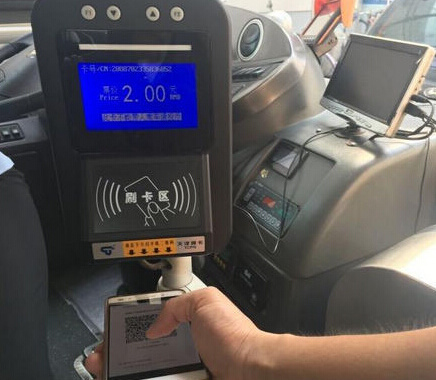
Running xxx bus two-dimensional code payment POS
The second is the provider of good QR code related programs. Internet giants to promote two-dimensional code bus payment, naturally have their own team to carry out a comprehensive program implementation. But what if a project promoter similar to Jinhua Public Transport Group wants to release its own APP to control the transaction information? It must be from the software development and testing, interface docking, equipment laying and other aspects of the relevant program providers. In addition, in addition to direct two-dimensional code bus payment, some urban transportation companies have now launched two-dimensional code self-service recharge devices to recharge bus cards on self-service machines through WeChat or Alipay's two-dimensional code payment.
However, for bus companies, there may not be strong enthusiasm to promote two-dimensional code bus payment. First of all, the deposit for issuing bus cards is a large income. The card-free payment brought by two-dimensional code will affect the bus company's income. Secondly, who will pay for the renovation of POS and whether the operation and maintenance costs will increase. Of course, there are also some benefits for bus companies, such as completing the registration of bus cards through APP to expand the business model. In addition, the two-dimensional code is more likely to be used as an entrance technology, providing greater imagination space for bus companies to expand Internet applications. In terms of experience, passengers who are accustomed to QR codes can feel the convenience of payment, and the support of multiple payment methods has increased the convenience policy advocated by the government.
Two-dimensional code bus payment how far
Liu Xiaojie, deputy general manager of Alipay's public service department, disclosed in an interview with the media that Alipay's bus code has already realized the scene of single ticket system. After the product upgrade, it will not only realize the scene of segmented charging, but also support complex scenes such as daily ticket and 3-day ticket.
A broader two-dimensional code bus payment imagination space is being created by the Internet giants. The public's dependence on two-dimensional code is becoming stronger and stronger. Under the favorable conditions of various preferential activities, two-dimensional code bus payment may have a better future. However, there are still technical shortcomings in the two-dimensional code, and the payment speed cannot be compared with NFC. Whether it can adapt to the public transportation environment still needs the test of time.
The realization principle of two-dimensional code payment POS is that a micro two-dimensional code OEM scanning module is installed in the device. This bar code automatic identification technology will be used by more and more people. 2016 will be a tentative year for two-dimensional codes in the transportation field. Various pilot projects will expose the advantages and disadvantages of two-dimensional codes in the public transportation field. It is believed that more and more provinces, cities and regions will launch such projects in 2017.
Focus on us
Official Account
Pre Sales
After Sales
National Service Hotline
Complaint suggestion:+86 13530144755
Enterprise E-mail:wanglili@xingyongli.com
Links:Shenzhen Hongxing Yongli Electronic Technology Co., Ltd.(Apply for friend chain plus QQ:2355671558)
©2024 Shenzhen Hongxing Yongli Electronic Technology Co., Ltd Powered by www.300.cn