

Pre-sales customer service WeChat


Jingdong fast delivery secret handheld scanning terminal is the key
Release Time:2014-06-12
Jingdong's fast delivery secret handheld scanning terminal is the key. Since the end of 2015, Jingdong's storage and distribution has been able to meet about 98% of Jingdong's self-operated commodity distribution, of which more than 85% of orders have been delivered on the same day and the next day. At the same time, there are distribution services such as night distribution (delivery from 7: 00 p.m. to 10: 00 p.m.) and fast delivery (delivery within 2 hours) to meet the various timeliness needs of different customer groups.
Why can Jingdong achieve such a fast speed? Why is the data acquisition terminal the key? Let's take a look at the actual operation process of an order from the order to the delivery.
When a user places an order in Jingdong Mall, his order can be immediately seen in the background system of the corresponding warehouse, almost in real time. This looks simple, but technically it is very difficult. Usually, in order to reduce the load on the system and the server and improve the stability, many third-party systems take the way of pulling orders regularly, but this will affect the efficiency.
By manual or system, incoming orders are automatically classified according to different labels, picking orders are generated and assigned to pickers. Picker can pick up multiple tasks at a time, up to 200 orders.
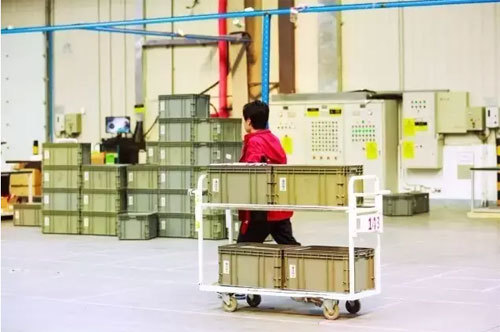
The picker trotted along the pick truck.
The PDA handheld terminal in the picker's hand will prompt him to find the location quickly. According to the recent big data, the system will adjust the location of the hot-selling and matching-selling related commodities to optimize the picker's walking path as much as possible.
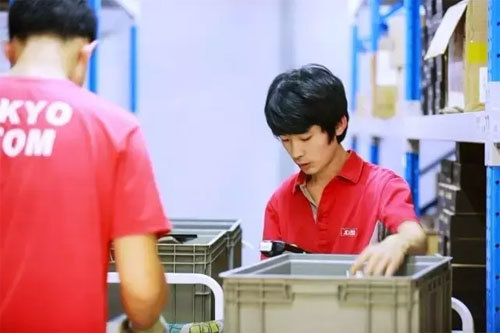
PDA Handheld Terminal Helps Picker Find Goods Quickly and Accurately
After the picker completes the picking work, he will put the turnover box on the sorting line. This factory-like conveyor belt is very intelligent. It can identify which are single product orders, which are compound orders and which are abnormal orders by scanning codes, and automatically transmit them to different workstations.
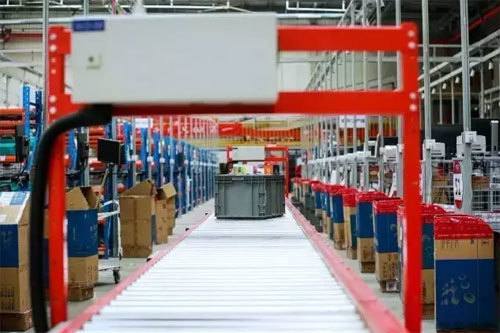
After the picking is completed, the turnover box is sent to the conveyor belt.
The reviewer moves the turnover box from the conveyor belt to sort and review the orders. Please pay attention to the plastic frame on the shelf behind her. When the reviewer scans the goods, the corresponding frame will appear on the big screen of the computer, and each frame corresponds to an order to ensure the accuracy of the order. All orders on this review table are multi-item orders, which means that the customer has purchased multiple items.
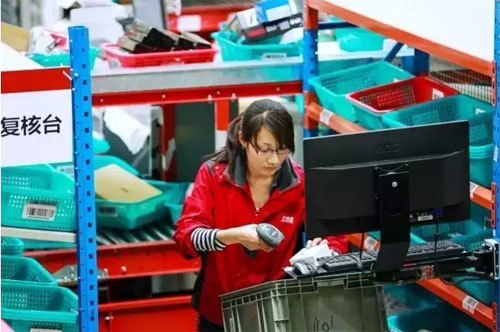
The reviewer is scanning the bar code of each commodity.
After sorting and reviewing, the plastic frame of the order is then put on a long conveyor belt by the reviewer, which will enter the next stage: packing.
This is a small packing station, and the packager has to scan the code again to check the information before packing. And then in accordance with the rules of operation, the use of plastic bagsOr small size the express box to pack the order goods and paste the adhesive sheet. If the user selects paper ticket invoice when placing an order, it will also be loaded together in this link.
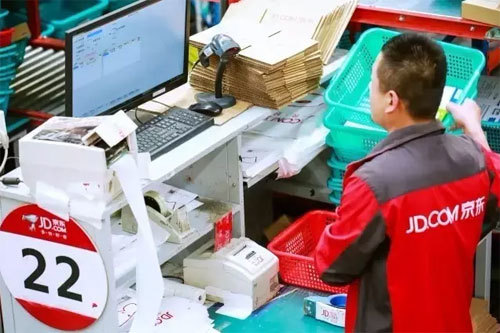
The packager packages the order.
The packaged orders were sent to the conveyor belt one by one. At this point, the consumer's order has been completed and delivered.
From placing an order to receiving the goods, the whole process takes only three or four hours. In other words, within the designated range of "211 time limit", users in some cities can place orders before 11 a.m. and receive the goods before 3 p.m. In other cities, due to travel and link factors, it will be slightly later, usually delivered to users at 4: 00 p.m. or 5: 00 p.m. (Source: Baidu Baijia, Author: Ant Worm)
Focus on us
Official Account
Pre Sales
After Sales
National Service Hotline
Complaint suggestion:+86 13530144755
Enterprise E-mail:wanglili@xingyongli.com
Links:Shenzhen Hongxing Yongli Electronic Technology Co., Ltd.(Apply for friend chain plus QQ:2355671558)
©2024 Shenzhen Hongxing Yongli Electronic Technology Co., Ltd Powered by www.300.cn